










The World Cup You Are Watching Is Not Like Any Before
AI in sports analytics has quietly become the most important development in modern football. While you were watching the opening matches of the 2026 World Cup Mexico taking on South Africa at Estadio Azteca, the United States kicking off on home soil—you may have noticed something different.
The offside calls came faster. The replays showed hyper-realistic 3D avatars instead of stick figures. The tactical analysis on your screen included metrics you had never heard of.
That is not just broadcast technology improving. That is AI in sports analytics, and it has become the “23rd player” for every team in this tournament.
The 2026 World Cup is the first where AI in sports analytics is not a side experiment. It is a core part of the game. This article explains what is happening on the pitch, behind the scenes, and why it matters for the future of sports including right here in Uganda.
Part 1: How AI in Sports Analytics is Changing Refereeing
The New Offside Technology
One of the most controversial moments in football history is the offside call. Was his shoulder ahead? Was the defender’s foot playing him on? By millimeters, titles have been won and lost.
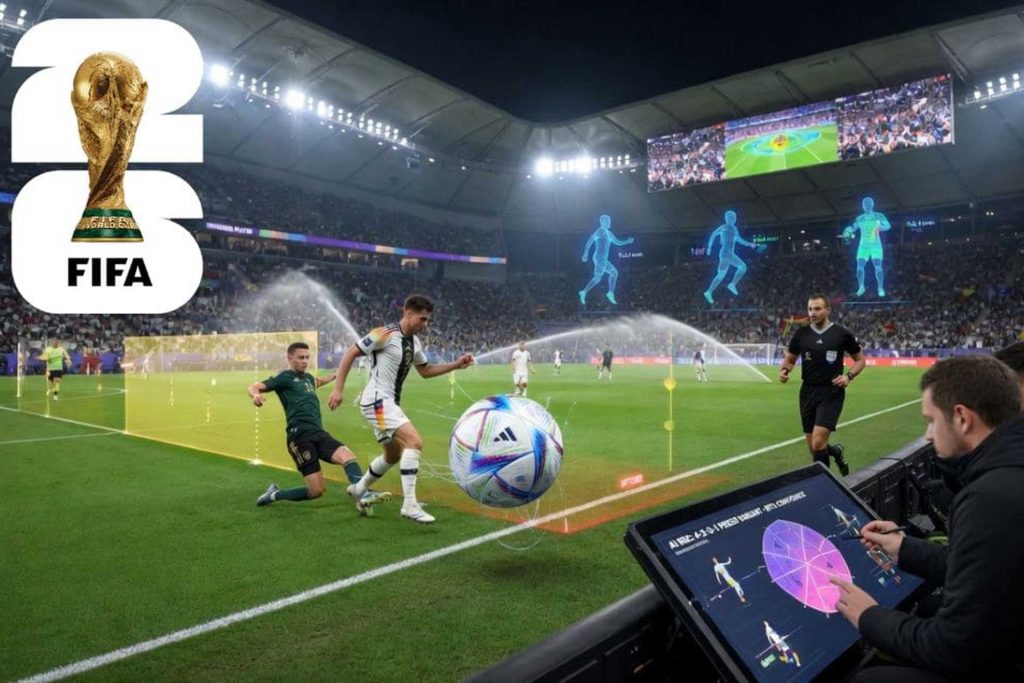
For 2026, FIFA has deployed a next-generation semi-automated offside technology (SAOT) that changes everything.
How it works:
Before the tournament began, all 1,248 players across the 48 teams were scanned in 3D. Each scan took about one second but created a highly accurate “digital twin” of every athlete’s body shape, size, and movement patterns.
During matches, AI processes data from multiple stadium cameras and sensors inside the match ball. When a potential offside occurs:
- The AI detects the violation within milliseconds
- An alert is sent directly to the referee’s earpiece
- A realistic 3D avatar of the players involved appears on stadium screens and broadcasts
- Fans see exactly why the decision was made—no more guessing
Crucially, the system can detect an offside when the attacker is ahead by as little as 10 centimeters. And unlike previous World Cups, the signal does not need to go through the VAR room before reaching the referee. It goes directly, saving precious seconds.

Why This Matters for Player Safety
There is another benefit that FIFA is quietly proud of. In the past, referees were instructed to let close offside calls play out, then raise their flag after the attack finished. This led to players sprinting, jumping, and colliding in situations that would ultimately be ruled offside anyway—unnecessary strain and injury risk.
With AI detecting offside in real-time, referees can stop play earlier, reducing dangerous collisions and protecting players from avoidable injuries.
Part 2: AI in Sports Analytics – FIFA AI Pro for All Teams
The Great Equalizer
Historically, top football nations like Germany, Brazil, and France employed rooms full of analysts. They watched hours of footage, crunched numbers, and produced thick reports for coaches. Smaller nations simply could not afford this.
For 2026, FIFA and Lenovo developed Football AI Pro – a powerful AI assistant given to all 48 teams.
What it can do:
Coaches and analysts can ask the AI natural language questions like:
- “How am I failing on offense?”
- “What formation leads to better outcomes against this opponent?”
- “Which players have historically defended best against Mbappé?”
- “What are the penalty kick tendencies of the opposing goalkeeper?”
The system processes over 2,000 football-related metrics and hundreds of millions of historical data points. It responds with insights presented as text, charts, video clips, and 3D visualizations.
The result: A team like Cabo Verde or Curaçao (making their World Cup debuts) has access to the same depth of tactical intelligence as Argentina or France. As one Lenovo executive put it, for smaller nations, “an AI tool like this isn’t a marginal upgrade. It’s the entire department, handed over for free.”
Learning in Real-Time
The system does not just rely on historical data. Within two to three hours of the final whistle, new match data flows into the AI engine. It learns and adapts throughout the tournament, meaning strategies can evolve between group stage matches based on the latest information.
Part 3: AI in Sports Analytics – The Referee’s Eye View
The Referee View Camera
One of the most innovative new features of this World Cup is the Referee View.
A camera is mounted on the referee’s body. Unlike body-cam footage from previous tournaments, this video is processed by AI-powered image stabilization that significantly reduces shaking and blur at high speeds.
What it gives fans: You see exactly what the referee saw at the exact moment they made a decision. Was that a foul? Was the contact enough for a penalty? Now you can judge from the same perspective as the official.

Virtual Cameras and 3D Reconstructions
The AI system also creates real-time 3D reconstructions of every play. From the network of tracking cameras and ball sensors, the AI can generate a “virtual camera” at any position on the pitch—including places no physical camera exists.
This was used to resolve one of football’s most debated scenarios: a player in an offside position blocking the goalkeeper’s view. Now, VAR referees can review the play from the goalkeeper’s literal point of view, created by AI.
Part 4: How AI in Sports Analytics Predicts Injuries
The Science of Prevention
While the 2026 World Cup showcases AI for refereeing and tactics, the same technology is quietly working in training grounds and medical rooms.
Recent research in machine learning has demonstrated that AI can predict athletic injuries with remarkable accuracy. A study published earlier this year in BMC Sports Science, Medicine and Rehabilitation developed an interpretable machine learning model that achieved 98% accuracy in predicting injury risk among college athletes.
The key predictors were:
- ACL risk score
- Load balance score (training-to-recovery ratio)
- Fatigue score
- Training hours per week
The study emphasized that injuries are not caused by a single factor but by the cumulative interaction of workload, recovery, and individual susceptibility over time. AI can track these dynamic relationships in ways traditional methods cannot.
Wearable Sensors and Real-Time Warnings
More advanced systems now integrate wearable sensors for real-time injury detection. Researchers have developed sports biomechanical injury prediction systems that combine:
- Nine-axis inertial sensors
- Flexible strain sensors
- Plantar pressure sensing arrays
Using an improved hybrid neural network, the system can identify high-risk movements before injury occurs. In basketball stop-jump tasks, it identified elevated knee valgus risk before the peak angle reached 16.2 degrees—providing a critical early warning window for intervention.
Post-Injury Performance Prediction
AI is also being used to predict how well a player will perform after returning from injury. Researchers have developed InjuryBoostStackNet, a hybrid ensemble learning framework that forecasts post-injury performance drops in professional football players with 97.95% accuracy.
This matters for coaches making difficult decisions: Should a recovering star player start the match? Or would a less talented but fully fit player contribute more? AI provides data to support that choice.
Part 5: AI in Sports Analytics and the Future of African Football
The Gap Is Closing
One of the most significant impacts of AI in sports is democratization. Wealthy nations can no longer buy their way to better analytics. The playing field is leveling.
For African football, this is an opportunity.
The Federation of Uganda Football Associations (FUFA) recently signed a memorandum of understanding with ISBAT University to develop homegrown football innovation. FUFA’s second Vice President, Azah Taibu, stated: “If we are to build a holistic football ecosystem, we need everyone on board. We are hinging a lot on data analytics, and our games require performance analysis”.
FUFA CEO Edgar Watson added that AI could be used to analyze detailed match data, including metrics such as the number of touches by left-footed players and duels per player. “These are very detailed aspects that the human eye, even for an expert, cannot detect live during a match. Yet they can determine match outcomes”.
The Research Gap
However, significant disparities remain. According to a 2026 study examining AI applications in sports science across the Global South, less than 8% of sports analytics investments occur in developing countries, and only 12.3% of AI-focused sports science research originates from the Global South.
Uganda is working to change this. The FUFA-ISBAT partnership, renewable for four years, focuses on:
- Educational inclusion
- Sports analytics
- AI-driven research
- Media development
- Capacity building within Uganda’s football ecosystem
The goal is to reduce the federation’s dependence on international consultants and develop “homegrown solutions that are contextually relevant to Ugandan football”.
The Talent Pipeline
For Ugandan students and professionals, this represents a new career pathway. Football analytics—once only available to those who could afford European education—is now being taught locally. Skills in data science, machine learning, and sports technology are becoming valuable not just globally, but at home.
As one FUFA official noted, the partnership with ISBAT University establishes a “research and innovation hub at the federation where young people can contribute solutions to challenges within the football ecosystem”.
Part 6: The Data Behind AI in Sports Analytics
90 Petabytes of Information
The scale of data at the 2026 World Cup is unprecedented. Storage device manufacturer SanDisk estimates the tournament will generate more than 90 petabytes of data – 45 times the amount generated during the 2022 World Cup in Qatar.
Every pass, every tackle, every sprint is being tracked, analyzed, and fed into AI systems that learn and improve in real-time.
The “Digital Twin” of Every Player
Remember those 3D scans before the tournament? They are not just for offside calls. FIFA has created a “digital twin” for every player – a complete virtual model that includes body dimensions, movement patterns, and even physiological data.
These digital twins are used for:
- Injury risk assessment
- Tactical analysis (how a player’s movement patterns match up against specific opponents)
- Broadcast enhancement (creating realistic replays from any angle)
- Medical monitoring (tracking fatigue and recovery)
For the first time, a player’s virtual self is as important as their physical self.
Part 7: AI in Sports Analytics as an Assistant, Not a Replacement
Despite all this technology, the human element remains central. PwC wrote in a January 2026 report:
“The goal of this application is not to replace the cheers of the crowd or the instincts of a good coach. Instead, this technology helps people focus more on what they do best: inspire, lead, and connect. AI not only doesn’t destroy the magic of sport, it actually enhances it.”
Even with FIFA AI Pro, the tool only matters if a coach acts on it. Any edge AI offers is still fully dependent on human decisions. As one analyst noted, “This is a preparation tool, not an in-match strategy engine. So humans are still in charge”.
The AI does not make substitutions. It does not give team talks. It does not inspire players to run that extra mile. It provides information. Humans provide the magic.
AI ref, human coach, robotic legs?
The Future Is Already on Your Screen
The 2026 World Cup is not a glimpse into a distant future. It is the present
- AI referees making offside calls faster than any human could
- AI analysts giving equal tactical intelligence to all 48 teams
- AI cameras showing you the game from the referee’s eyes
- AI models predicting injuries before they happen
For African football and Ugandan sports science, the message is clear: The technology gap is closing, but only for those who invest in skills and infrastructure.
FUFA has taken the first step with ISBAT University. But this is just the beginning. The next generation of football analysts, data scientists, and sports technologists are not being trained in London or Munich. They can be trained in Kampala, Nairobi, and Accra.
The World Cup is happening now. Watch the matches, but also watch the technology. You are witnessing the future of sports – and that future includes you.
Are you watching the 2026 World Cup? Have you noticed the new AI-powered refereeing and analysis? Share your thoughts in the comments below.
Ready for more sports tech content? Check out our series:


